How comedy can compete with football…

Years ago when the Bengals were actually good, an improv group I was in was booked for a Monday night show at the Cincinatti Funnybone.  Before the show they had the game being projected on a large screen at the back of the stage.  It was getting interesting when…showtime!  Game off!  Here’s 6 white boys from Columbus!  Obviously it took awhile before their minds were off of football.

As you travel the road in the fall you sometimes have that inevitable gig that happens during or right after the big game.  In Topeka I once performed in front of a dozen people while the next room over, the sports bar, was jam packed for a Chiefs game.  Of course the ultimate challenge is performing on Super Bowl Sunday…or is it?  If everyone else is watching the game but you still have any kind of an audience, assume they really like comedy.  I still consider that show in Topeka my best set with less than twenty in the crowd.  Take the attitude that these people are really interested in your show.

So what can you do in other circumstances when you’re competing with football?  If you arrive early enough to the gig, have them turn the television off or at least put the game on in the bar instead of the showroom.  Let people decide where they want to be.

If it’s after a big game (a loss), it’s okay to mention it to the hometown crowd that yeah, the game sucked, but drink up and forget about it for a little while.  Never taunt them about a loss!  (This includes years later as I learned in Huntington, WV when bringing up the OSU vs. Marshall 57-yard FG game 4 years after it happened)  If they won the game, mention it for an easy way to get them on your side.

Avoid wearing a shirt from your favorite team unless you’re in ground zero of their territory.  Even if you don’t mention it, it could invite heckling, especially if it’s an NFL shirt.

For more tips involving sports and comedy (and wardrobe advice of course!), check out my book, Don’t Wear Shorts on Stage.

How to work with a bigger name…

Last Sunday I was trying to check into my hotel room at Lake of the Ozarks when there was a small problem.  The front desk gave me the phone and said it was the guy who runs the room and booked the hotel.  “Hey Rob.  Are you just going to pick up the keys for everyone?”  For some reason he thought that I was touring and good buddies with Rob Schneider, the headliner, and that Rob Schneider would be okay with sharing a suite with me.  Ten years ago I probably would’ve thought that was cool, but as a grown man I don’t want to share anything with anyone, nor does the headliner…especially if he’s famous like Rob Schneider.  I got a different room.

The only reason I got to work with him was because I have a reputation for working clean.  When a headliner has pull, he can request that (I mention all the other benefits of working fairly clean in Don’t Wear Shorts on Stage).  Schneider ended up walking through the back of the room halfway through my set which distracted the crowd somewhat, but with headliners who are famous, especially in smaller towns, the room will be filled meaning I could sneeze and get a laugh.  Record your sets with someone famous.  They make good demos, however, don’t get inflated by how well it goes because those people are excited for someone after you.  It’s also okay to joke about that.  “Hey, we’re all excited to see (headliner), I am too.  But let me help you get a few drinks down before that.”  Acknowledge, but don’t apologize for going first.

Your interaction with the famed headliner is important too.  Exchange a hello after your set if they make eye contact, and let him/her compliment you.  Instead of trying to blab that you’re a fan let him or her speak, record all that in your head and use it as a quote (stick it next to a picture with him on Facebook or your webpage and watch those oh-so-validating “likes” come in).  If you’re working with him/her the entire week or weekend, wait a couple shows before holding a conversation.  They’ll listen to at least a little of your set and be happy to chat if they respect it.  Keep it brief and let them be alone if that’s what they prefer.  A lot of them aren’t used to the road full-time so they’re weird about interaction.  If they like you, you could get future work with them.  Other than that and the great crowds, it should be just another gig.  People think we get to work with big names because we’re special…nope, just lucky that week.

Time to move on…

In 2004 I had been doing comedy for four and a half years and was spoiled as far as early stages of a career go.  I was MCing the Columbus Funnybone on a regular enough basis with shows that often sold out in the middle of the week.  300 people on a Tuesday or Wednesday is not common, but it’s hard not to do well at a club with that much enthusiasm.  Later that year I found myself failing to even advance to the finals of the local contest.  Why?  Because I had hit such a comfort zone that I wasn’t progressing as a comic.  This was more than just not writing new jokes.  I didn’t feel the desperate need to improve.  Occasionally you’ll work with headliners with this same problem.  They have the same 45 minutes every year because “it works” for them. 

Moving from Ohio to St. Louis was the best thing for my career for a lot of reasons.  The first being that it gave me more life experience.  Second, it put me in a crowd of many more professional comics (no offense to my pals in Columbus, but when you’re sandwiched between comics like Tommy Johnagin, Greg Warren, and Andi Smith you have to up your game).  I was able to get a lot of great feedback as well.  The move was because of comedy so it made me take my career that much more seriously.  There were fewer distractions (friends) here so I had more evenings for open mic.  There were also more clubs here in 2005 (four within a half hour drive).  The open mic night options alone quadrupled my stage time.

I’m not saying doing this as a commercial for St. Louis (only one of those clubs is still open), but consider whether you’ve hit your ceiling in your home city.  It’s a well-known fact that your home club is the hardest one to get promoted in.  They’ll always remember how you used to be.  When you get to a new city and they know you moved there because of your career, it shows that you’re committed.  It also gives you and your reputation a fresh start. 

In Don’t Wear Shorts on Stage I discuss this option a little further including advice about L.A. and New York.  Moving aways can be expensive and stressing, but that’s what getting your start in comedy is all about.

Umm…

Early in my career as my friends came to a lot of my shows (because it was still cute that I had a dream) I welcomed their feedback.  They weren’t comics, but I don’t think someone has to be a comic to give good feedback early on.  I’ll admit, it’s annoying when it comes from a non-comic sometimes, but it was more about my stage presence.

I said, “Umm,” a lot.  Listen to your recordings.  Do you say “umm” a lot too?  At all?  Do you have a different noise (uh, you know, sooo)?  My “umm” went away after a couple years without me even realizing it.  The reason?  I knew my jokes well enough that saying them became automatic.  In other words, it took years of a lot of the same routine to get the “umm’s” out of my speech.

One of the most enjoyable parts of comedy at this point in my career is getting a new joke to work.  Newer comics experience this too, but too many times some are quick to move onto new things before building a solid “umm-free” set.  Umms don’t sound like a big deal and as comics we probably don’t even notice ourselves saying them, but it’s the difference between building an okay set and an extremely solid, money-making one.  The people who book you notice the umms.

If you’re not getting enough shows to recite your jokes enough to put the wording into autopilot, it’s time to practice at home, over and over.  To gain another level of respect from an audience, they need to hear your jokes umm-free.  It’s okay to do the same jokes month after month and even year after year.  Professional comics do that.  The guys who have multiple HBO Specials like Chris Rock have multiple writers (not that you should be comparing yourself to them).  Build up your act and use the same jokes if they work (that last part is very important).  Once they work, stretch them out with other funny lines, callbacks, and other dimensions.

The important thing to remember this week is that you have to have enough repetitions of your jokes to make them come out without umms.  Stop worrying about boring your fellow comics that you see at the same open mic night.  It’s your act and career, not theirs.  Once your memorize your bits to the point of not having to think about what you’re saying, there’s so much more you can do with them.  These extra techniques are mentioned in Don’t Wear Shorts on Stage so feel free to order a copy if you haven’t already.

Find a stage without fear

Saturday night I went to a local open mic that only had under ten audiences members there.  A few other comics were in the crowd but the room still had under twenty people.  I went there on a whim so I didn’t have much prepared.  I was chatting with a buddy after our sets and he said this is the one stage where he doesn’t have any nerves about performing.  He didn’t mean that he’s a nervous wreck at other venues, but I completely understood him.  Over the years there have been open mics that are much more relaxed.  Normally, it was the open mic nights at actual comedy clubs where I couldn’t relax which disrupts flow and sometimes new ideas.  The nerves at a club are natural, there is a chance for paid work there.

As a comic, especially one who is trying to find his or her voice, it’s necessary to take risks on stage.  Big risks, stupid risks, risks you want to forget you ever took.  Risks you hope your fellow comics will soon forget so they don’t bring it up for years to come.  “Remember that time you had that sock puppet read a love poem in Bill Cosby’s voice?”

Unfortunately a lot of cities only have one place for open mic night, the comedy club.  If that’s the case my advice is not to take such big risks that will permanently damage your reputation with the club manager.  Instead, find a place to experiment (that’s the word I’ve been looking for) even if it means starting your own open mic.

This also works for first-timers.  I’ve got lots of tips for first-time comics in Don’t Wear Shorts on Stage that come from the mistakes I see every week at open mic (and the many that I’ve made).  So if you’re still on the fence about trying I’d say find a less formal venue than a comedy club and read my book.

You’re not a comic! (Semi-annual post to comedy fans)

Comics, please feel free to share this with your fans and followers…

In January I wrote an entry that was aimed more for the friends who support you.  This entry will address an issue that came to life at a one-nighter I did last Friday.  If you’re a fan of stand-up, let me first thank you for supporting the art, going to shows, buying books, t-shirts, CD’s whatever else we sell after the show.  We need that money to pay for things like food and life.  95% of you are great and we thank you for making our careers possible.  I also understand that most of the time at a comedy show you’re drinking and maybe not at your best.  We know you wouldn’t normally have the balls to yell something dumb out during a show, but even after just one or two drinks it doesn’t seem that hard.

For the past month there have been various controversies with comics vs. crowd members.  Tosh, Pescatelli, Eddie Griffin, etc.  Those were all big news to the comedy world, but a lot of us comics have seen or experienced worse.  There just wasn’t an iPhone there to capture it all, plus we don’t have television shows so no one cares if anyone throws a glass at us.  One of my friends had a guy threaten to take his life with a gun a few years ago, it didn’t make the news. 

I know none of you are the extreme crazies who are going to make the news, but there is still something annoying that comics have to deal with usually after the show, although a lot of times during.  You feel the need to be funny too.  When you go to a football game, do you tackle people in the stands?  Just relax and let us do the ha-ha’s. 

I bring this up because a lot of times crowd members, usually hammered, think they have a license so get away with certain types of humor.  I’ve written an entry on here, and a section in Don’t Wear Shorts on Stage about the right and wrong ways to joke about race on stage.  The key words being on stage.  Here’s what happened the other night.  I was working with a black headliner in an all-white town.  When this happens a black comic must point out that he’s the only black guy around.  (I say must because it happens 100% of the time, I guess there are exceptions so I don’t need comments arguing this.)  The comic’s job is to be funny and that helps.  The audience doesn’t have that right to make racial jokes back.  Their job is to laugh.  Not to mention hangings, ropes, sheets, and lynchings.  Common sense to most of us (it was a rough gig though). 

I know (hope) most situations aren’t this extreme (yes, those words were actually mentioned in heckles on Friday).  However, after the show and the apologies by the bar owners and some audience members, one guy who was married to one of the apologetic, still felt the need to tell a black joke to the black headliner.  His logic was that he had just told me one involving a teacher who molested him (because I’m a teacher so I’d get it?), so he had to have one that related to the black comic. 

I realize I’m preaching to the choir on these obvious and extreme examples, but you’d be surprised at the number of black headliners who have to suffer through racist jokes after a show.  There’s something in a drunk redneck’s brain that says, “This is my one chance to deliver a black joke to a black man with no consequence!  Finally I get to feel what the 50s were really like!  Grandpa will be proud.”  No it isn’t.  I’ve heard the people on the Comedy Central Roasts have the same problem on the street.  People walk up and slam them with some low blow because they think that’s what those people enjoy.  It isn’t, the roast aired five months ago.

As for me…white guy who isn’t known for anything but the thirty minutes they just heard…I don’t really want to hear any jokes either.  Your breath smells like vodka, it’s loud, I can’t understand you, and you’re blocking my table of merch that I need to sell so that I can fill up and drive home from your ignorant-ass town.

One last thing, never suggest bits to us.  In twelve years I’ve never used anything from a crowd member.  It’s degrading when people start, “I don’t know, you can probably use this in your little skit…”  No.  We can’t.  Perhaps you’d like to try it on stage?  I know a good book that helps you get there.

I’m not mad, just stop suggesting and telling jokes to us after a show.  I can’t think of any comics who enjoy that.  There’s lot of other things to talk about and we’re happy to have conversations with strangers to prevent the road from being so lonely, but leave the comedy to us.

Why “the road” isn’t the ultimate goal

For years comics work and work to get “on the road” full-time.  As soon as we get a few weeks strung together we feel like seasoned pros and start big-shotting our way around the open mic scene name-dropping clubs and pretending that most of them don’t involve at least two shows during the week that have less than thirty people.  Then after a few years most of us realize the road sucks.  The diet, the travel, the way certain clubs treat us, the lack of money, the time away from loved ones all gets to be too much.  I only work a few clubs now and as some of you know, have accepted another full-time teaching job at a high school.  My act is really good for a feature (congrats Rob, it only took twelve years) and I could tour full-time, but I have chosen not to.  Other friends have made the same choice .  So is it really that bad out there?  I think what happens to some of us is that we reach an age where we can no longer tolerate all of the little things.  In Don’t Wear Shorts on Stage you can read about the exact moment I realized it was (it involves an ankle and my car).  Some might not understand, but I’m not alone on this.  It’s kind of like drinking…in your 20s you can bounce back from anything no matter how rough it is.  In your 30s it becomes more painful and smaller things get to you.  I can’t imagine how it is by the 40s and 50s.  My hat goes off to those who do it.  Making headliner money obviously helps, but if you talk to a lot of those headliners, they’re not the happiest and healthiest people on Earth.

So here’s an old blog I dug up from my livejournal from the last year describing some of the little things that built up and got to me.  Call it whining if you want…I call it motivation to find other outlets.  If you had been working at a job for twleve years and your company sent you to this hotel, didn’t pay for your food or travel, ignored any hope of a raise year after year, and considered it normal you’d be whining too.

I checked into my hotel at four in the afternoon after a half-day drive only to have to wait another ten minutes in the lobby for them to “finish up the room.”  I walked over to a nearby Wendy’s and ended up paying almost $7 for a salad because at the sight of my $2 off coupon the manager told me, “We don’t take those.”  I finally check in, drag my bags upstairs and get to a door that doesn’t open with my keycard.  I drag my bags back downstiars, get stuck in line behind a family reunion who is checking in (this family has lots of children) and wait another ten minutes before I get a keycard that works.  I walk back up the stairwell with my bags.  The stariwell smells like piss, as in someone actually peed in the bottom of the stairwell (at least it was outside), and notice a smashed cricket (science class disection size) on the steps who happens to stay there all week.

I finally get to my room, set my bags down and lie down on the bed.  I grab the remote and turn the television on, or at least try to.  Nothing’s happening.  I call down for new batteries and am told I’ll need to come get them because she’s “on her own, honey.”  I walk by two maids and a maintainance guy on my way down to another five minute wait at front desk.  That was Thursday, day one.

Friday morning starts at 5:30 a.m. when the couple next door has smoke chat just outside of my door.  This of course includes the ceremonial morning hacking that a lot of smokers experience.  When I finally fall asleep later on, a nearby car alarm takes its turn as my snooze alarm.  The free hotel breakfast has been taken over by the family reunion and why wouldn’t you let an eight-year-old use a waffle iron?  And sure, have someone even younger pour his own milk.  I always get my mini-yogurts, generic cereal, and stale muffins to go.  What’s better than carrying your breakfast through piss corner and my little cricket friend pictured above?

I get a bottle of water out of the micro-fridge and after just one night it’s frozen solid.  That’s okay, I’ll make coffee and drink it–nope!
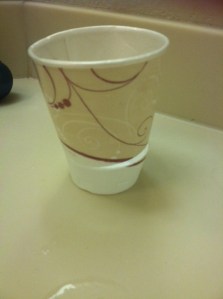
The cup is pre-sliced like a loaf of bread.  I didn’t realize this until coffee was spilled everywhere which soaked my audio-recorder that I had spent $50 on.  Day two is awesome.

When I get back to my room after an afternoon out on day three I noticed they’ve cleaned it.  I didn’t notice that my iPhone plug adapter was missing (until I got home).  Also, my room suddenly smells like a cigar.  Neighbors again, at least it’s during daylight hours.  I’m about to hop in the shower (that’s right ladies, I’m naked at this moment) when I realize I have no towels.  They cleaned my room, took my towels and failed to replace them.  (I’m not naked anymore)  I call down to get towles and of course, she’s the only one there who is qualified to carry towels so I have to get dressed and go get my own.  It’s now pouring rain at this point and oh, the irony of carrying towels back to your room in the rain.  I stride by Squishy McCricket and shower after a natural prerinse from my journey.  After my shows, night three ends with two TV dinners in the microwave I have to reach back, unplug my lamp and fridge for, and plug in.  Mmm MSG.

I spend most of day four away from the hotel as I have given up on ever getting in the pool.  It’s packed with loud kids the entire time I’m there.  I come back to my room which has been neglected.  Not a huge deal except that I’m out of shampoo (another too-late-I’m-naked discovery) so I get dressed and head down to front desk for that because I know better by now that calling would do anything.  I have a theory that maybe the hotel was filming a reality show and I was playing some sort of role.  Did they need a reoccuring guest to keep coming to front desk and asking for things just to fill the hour? (Yes, for some reason my imaginary show “La Quinta Chronicles” is an hour long).  It’s possible, the woman up there was on a first name basis with me by day three.

Anyway, I grab what should’ve been a cold bottled water on my way out to my fourth night of shows only to realize that I never plugged the fridge back in after I used the microwave.  At least nothing was frozen except another MSG dinner, just room temperature warm.  Also an excuse not to have to eat night four’s microwave meals.  I walk in the rain to my car which is parked on the other side of the hotel because when I got back the previous night the whole lot was filled on my side.
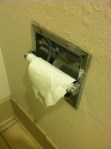
Did any of these things kill me?  No.  Can I change my own roll?  Yes.  The point is that week after week little things like this tend to wear on someone.  It’s not a tour bus and four star treatment.  I don’t blame the clubs, most of them aren’t making much money right now.  I’m at a point in my life where I enjoy doing shows just enough to put up with this stuff for a few weeks a year.  I’m fortunate enough that the club that uses me the most, the St. Louis Funnybone, is eight minutes from my home.  So unless I magically become a headliner with a demanding contract, I’m content with just a few weeks away from my comfortable life at home.  I just turned thirty-five (on Sunday) and am apparently a big baby when it comes to travel now.  That’s fine, it leaves more weeks for you.  So when you get on the road, use that free time to work on other projects or improve your act so much that you can write your own contracts with clubs.

www.robdurhamcomedy.com

3 Facebook promo suggestions not mentioned in my book…

We helped ruin Myspace.  Everyone thought they were going to market like Dane Cook and become famous to millions via the internet.  We didn’t even really post anything funny, just pictures, our schedules (remember the guy who would post all three Saturday shows on his calendar to make it look fuller?), and the invites.  Oh, the invites.  The one major thing flaw has carried over to Facebook.

1.  Stop inviting everyone to everything…

Be selective with who you invite or your friends will use the greatest Facebook feature ever created, Ignore all invites from (open mic comic from NY city who’s never performed in a paid show).  I estimate over a hundred people who I’ve added to this list (which also includes garage sale invite lady from the Midwest).  I understand you have bringer shows in some cities but if you want your friends to come, call them and invite them like an adult.  If you’re not close enough friends to call, they probably don’t want to see you do four minutes of “gettin’ better!” anyway.  Always avoid inviting people who live in a different city/time zone.

2.  Be funny on your own with pictures and status updates…

Yes, occasionally you see a funny meme, but sharing a half-dozen e-cards that some stranger (also from the Midwest) thought up bragging about how early in the day you’ve started drinking doesn’t make you a comedian.  Anyone can share material that someone else thought up, write your own funny captions or status updates.  If you can’t, then you probably know why none of your friends are coming to see you at open mic.  I understand, sometimes a meme makes a point or political statement that you want to share, but the allout-wacky-for no-reason stuff…no.

(Side note: Your political statements aren’t changing anyone’s mind, you’re just causing more anger and polarization amongst your following).

Sorry, I’m starting to sound mad, I’m really not.  I’m venting on behalf of the dozens of friends and fellow comedians who also mention these things.

3.  Tone down the show posters…

Your audience has become numb to these as well.  Anytime there’s a flashy poster in my Facebook feed I immediately ignore it because it’s one of dozens.  It’s overcompensating.  I’ve heard a lot of the headliners in the business (the guys who you want to respect you so they’ll help you out later on) mock these as they skim through Facebook in the green room.  I know they’re not hard to make, but spend that time writing new material or improving what you have.  Artistic promo isn’t going to make your career.  Also, if you want your show to sound professional, don’t title it, “The Broken Tampons of comedy proudly present…The Shit-Slackers!”  Be funny during the show and people will go to more of them.  Who do you want as your following?  People with money…or Beavis?  Respect your career without taking yourself too seriously.

Remember when you used to scan through your feed and stop and look at pictures?  It’s gotten to the point where I’m skimming through the abundance of pictures and actually stopping when someone actually writes something because it’s so rare.

Here’s a tip for promoting your show.  Mention it in a status update along with a mildly witty comment.  It doesn’t have to be hilarious, just something cute and modest.  Overdoing marketing voids the amount of Facebook friends you have because they’ll ignore all of your updates.  It’s a fine line, I understand.  I’ve felt the backlash from selling books and giving free advice every week.  My excuse is that I’ve received a lot of positive feedback and I’m actually making money…and I fancy myself a decently funny status update writer so I get to scatter in a few commercials as a trade-off, right?  And all this free advice that isn’t even from the book.  Anyway, order Don’t Wear Shorts on Stage here…

www.robdurhamcomedy.com  or click the icons in the right margin.


Please feel free to  share this post.

What if they mess up the light?

Note to non-comics:  The light is a signal from usually the back of the showroom to the comic telling him or her their time is almost up.  Most comics get this signal with five or ten minutes left to go depending on what they setup ahead of time with the club.

In one of my shows this summer I saw the light around six minutes into my set.  I had been doing twenty-five minutes all week so I was thoroughly confused.  I did twenty and went straight to the manager to asked what happened.  He was furious at a doorman who was “playing with his flashlight” for no reason.  The light was a mistake and I shorted myself five minutes.

I was talking with Jeremy Essig (yes, I get my advice from the same 4 people in all these posts) about it and he said that if there’s a light that confusing he’ll pause and actually address it.  This is probably something I should’ve done  because between every joke I was looking back to see if another light was coming or worrying that I was supposed to be off ten minutes beforehand.  It really threw off my timing and concentration.

I was a doorman for three years and sometimes the light is messed up (not by me of course, but by my fellow doormen).  For a five to seven minute set I’ll get a light with two minutes left, but if it’s anything over that there’s an easy way to make sure that I stick to my time.  I’ll tell the club that I don’t want a light because I have my own timer on my phone.  Doormen seem to have a two to three-minute margin of error and you don’t want to risk that so it’s best to be in charge of it on your own.  The important thing is that you ask the manager within ten minutes of your set how long he or she wants your set to be.  That way there can be no confusion.  It’s important to remember that if you’re ever given a second light, get the hell off the stage, they want to move the show on. 

With smartphones it’s easy to set a timer.  If I have to do twenty-five minutes, I set my phone to vibrate at twenty with the automatic snooze reminder five minutes later.  That way at twenty, I’m notified I have five minutes left.  Then at twenty-five I know exactly when to wrap it up.  Leaving it to a doorman as most clubs do can be risky as they often have other matters to tend to (although with this week’s comedy club national controversies it sounds like some aren’t doing their job!). 

For more tips about the previously unwritten rules of comedy, please check out my book Don’t Wear Shorts on Stage, which is available in multiple forms from Amazon, iTunes, Kindle, Nook, or straight through my webpage for an autographed version.

Must the show go on?

Over my twelve year career I’ve been lucky enough not to have too many crisis-type situations during a week that I’m working.  Things in life pop up though, and as comics we can’t exactly phone in sick.  People get hurt, people fight, people run out of money, people develop problems, people have surgery, people die.  Sometimes these things happen right before showtime.  Either way, the comic has to put it all behind him or her and make people laugh for the entire set.

My worst case of this happened near the beginning of my career when I was emceeing a three-show Saturday in Columbus.  One of my best friends was in a bad motorcycle accident and our mutual friend informed me by phone ten minutes before the first show.  I’ve witnessed other comic pals handle hardships and still perform as well.  I can’t really give you advice on how to “put it all away” for however long your set is, but I’ve found that performing is actually a nice distraction from dealing with reality.  This was especially true the year I suffered through teaching in the inner-city (I really hated life but my stand-up really improved).

Bookers and club managers seem to understand about the death of a loved one.  A week off isn’t asking too much in those situations and with everyone sharing their losses on Facebook, no one dares to fake anything.  Anything short of death, and I advise that you somehow try and perform through it.

Here’s a quick little tip I learned from Rahn Ramey this week.  He said he never talks to anyone on the phone two hours before the show (unless it’s business related).  By doing this you can avoid conflicts or Earth-shattering news before you take the stage.

And finally, to those who keep bitching about my book plugs, stop reading here.  God forbid there be a small advertisement for all of the free advice I’ve shared with you.  For the rest of you who don’t feel physically violated by a hyperlink click here to order my book off of Amazon or the links to the right to get a signed copy straight from me.  For those who already have, thank you, and please leave a review (but only if you enjoyed it!).