This is a lesson I’ve learned the hard way because I have a freakishly great memory, especially when it comes to interactions with important people (in this context that would be successful comedians and club managers). In comedy you can go months or years before encountering the same people. Assume the encounter wasn’t as big of a deal to them as it was for you.
So if they say, “Nice to meet you.”
Don’t counter with, “Actually we met 2 years ago when I…”
Here are my two reasons…
First, it makes them feel awkward/bad because even though it’s just little ol’ you, they have a conscious and a meaningful moment for you didn’t stick in their memory. They’re likely to exit the conversation early.
The second reason is even more important. If you weren’t funny enough to be remembered, it’s a blessing that you get a fresh start.
I regret that the first few years of my career when I lived in Columbus, were the same years I opened for the biggest names (2000-2005). I thought I was funny, but in retrospect I’m ashamed the only impression I ever left on Dave Attell (and other comedy heroes from that era) was that of a cringy 10-minute set.
I had multiple interactions with Ruthann (Crackers in Indianapolis) and every time I did a guest set or featured it was similar to The Simpsons gag of Mr. Burns not remembering Homer Simpson. The final guest set I did for her (circa 2019?) impressed her so much she offered a week right away. Like an idiot, I reminded her that I’d already featured a week a few years prior. Several email attempts later, nothing ever came about.
You’ll improve exponentially through (at least) your first 15 years of comedy. Don’t remind someone who can help you of the comic you were years before. Let them gain a fresh perspective of you at the level you’re currently at instead of making them feel awkward and reminding them of the less-experienced comic you used to be.
For more advice on making money in stand-up comedy, check out my book, Don’t Wear Shorts on Stage. It’s available in paperback, ebook, and audio.
Recently my friends on the hilarious and inciteful podcast, The Consumers, held a discussion on what a tough room was. They specifically mentioned the Little Rock Looney Bin. I haven’t worked there since 2008, but I do recall advice about not making fun of Arkansas on stage (yet I still learned my lesson the hard way), and can attest that it has always been a tough room.
Nowadays, I make a bulk of my comedy earnings on stages that aren’t in comedy clubs: event halls, bars, and most recently a church. Some of these venues make even the toughest comedy club look easy. This post will explain how you can make these rooms a little less challenging ahead of time with variables you can control, and if you can’t, how you can prepare to still salvage a decent set.
If you have any say in the room setup here are some quick fixes:
Be sure they’re seated very close to whatever serves as your stage and there aren’t dozens of extra chairs near the back.
Have them use a spotlight on you and turn down the house lights. This can make all the difference so mention it during your actual booking agreement.
Discourage any other distractions during your show including silent raffles, a smoke break between comics, televisions showing the game, and eating. (I recently performed a gig where the caterer was running behind so badly they served dinner right before I went on stage. People can’t chew and laugh at the same time.)
Other challenges include a venue with a high ceiling, faulty acoustics, an odd-shaped room where many struggle to see, and a bar in the back with talkative patrons who aren’t there for a show. If you have round tables, you’ll have people who aren’t even facing you. Invite them to turn around in your opening remarks.
Ultimately, a crowd is what makes a room hot or cold, but before I alert you on what to look for, there are a few other factors that can make a room more challenging…
Showtime: In the summer, if it’s still light out, like a concert a comedy can lose a lot of the vibe if the room has windows that leak even a little light. On the contrary, late shows can be even tougher (a 3rd show Saturday starting at midnight was standard at clubs when I started out 25 years ago). Typically, a late show on Friday is the toughest at a club because people are tired from being up early for work, plus they’ve been drinking for hours.
Openers: If you have a host or feature before you and they’re filthy or always interreacting with the crowd, that can make your job more difficult. If you’re a headliner who can choose your openers, consider these factors. Also, if your opener bombs, you may have to dig your way out. Do your best to pick up the pace right away so they realized you’re worth staying to hear. I’ve even resorted to waiting near the door and telling them how the show will improve if they’ll patiently stick around.
With crowds, I believe age is becoming a large factor. Our Tuesday night open mic at the St. Louis Funnybone has been plagued attended by people in their early twenties. For some reason, they don’t laugh much. At any of us. Even touring headliners struggle. We theorized it had something to do with habitually watching short clips on a phone and enjoying something but just not openly expressing it with laughter (the high school students I teach agreed with this theory). Maybe we should install “like” buttons at the table. Whether my theory is right or wrong, young crowds are tough. On the contrary, I once worked a 50th class reunion (everyone was about 68) and they (physically) struggled to laugh all that much. Luckily, the band on after me led the laughter.
Consider extreme age groups and the references you make. Will they get allusions about 80’s music and whatever happened to (insert famous influencer)? Probably not.
Gender can also play a role. If it’s a normal mix, it’s not a factor. If you’re working an all-male room (country club member’s tournament afterparty) you’ll get some “macho” hecklers. If it’s a private event bachelorette party that’s all women, you’ll also experience a different behavior from the crowd (sponsored by Tito’s).
I had the honor of opening for Fortune Feimster in a theater once. After my first joke I realized the crowd was 90% women and had to adjust my setlist on the fly. Consider what you can get away with and what you can’t if you have a crowd of mostly one gender.
Groups vs. Couples: The more groups in the crowd, the rowdier it’s likely to be. People become fearless in front of friends. Couples nights (Valentine’s shows) are overly tame because people tend to be more worried about their date than letting go.
Political affiliation can also make a room tougher, and I’ve experienced extremes from both left and right. Years ago I didn’t do well because a crowd in a “hip” neighborhood in St. Louis got easily offended by some of my bits. I’ve also walked into rural bars with Trump signs in them. I don’t directly mention politics in any of my jokes, but by watching a comedian’s set you can often tell which way they lean. Consider jokes you might have to cut from your setlist.
There are a few other factors I left out, but you can find them on the video below. Feel free to comment anything else I may have overlooked and share what your toughest room was. And if you want to learn more about making money in stand-up comedy, check out my book, Don’t Wear Shorts on Stage available on Amazon.
Authors have a phrase, Killing Your Darlings, in relation to editing. It means going back and removing your favorite scenes, settings, sentences, characters or plot twists. It might even be the thing that inspired the story. These elements seemed perfect when you wrote them on the page because sometimes, “this really happened in real life!” but many times they doesn’t make for a good book.
Comedians need to do the same thing with jokes.
Sometimes a beginner comic gets a big laugh on a joke. The advice is to build a 5-minute set, so that comic continues to use that joke over and over. Jokes can stay in an act for years (“You don’t say, Durham!”). And most of us comics aren’t pumping out specials and starting over with a new hour every few years, so these trusty bits fester into “classics.” Eventually, you have to say goodbye to even your best jokes.
The closer I used for the first 5 years of my career…the one that got the biggest laughs and loudest response in my entire set…was holding me back, and I was too blind to realize it until a peer/mentor finally told me how stupid it was and that it didn’t fit the rest of my act.
Trust that as time goes by you become a better joke writer and your voice becomes stronger. Even if your new bits aren’t polished to perfection, you have to kill your darlings and replace them. Otherwise, your act and your stage presence becomes stale (and comedy can even get boring).
This week I’ve replaced quite a few “darlings” in my setlist and they aren’t all going to do as well as the older stuff. However, my supporters and the club will appreciate the change and growth. My best shows are when I’m not in auto-pilot, and as someone who’s been doing stand-up for 25 years, trust me, I’m often in auto-pilot. Having to think about the bit I’m doing will help the performance.
So how do you know which bits to kill? Ask the other comics who’ve seen you at dozens of open mics. Ask the club manager (if he or she watches regularly). Ask a headliner. If they’re honest, they’ll tell you what to nix for good.
Be sure you’re getting the right kind of laughs instead of cheap, stage-prop laughter. Years later you’ll look back and cringe at what you used to think was your best joke. Seriously though, kill it now.
For more advice on how to make money and advance in the comedy business, check out my book Don’t Wear Shorts on Stage.
10.It’s our only job. Almost every comic has some other side hustle to help pay the bills. Substitute teaching, tutoring, driving Uber, commercial work/modeling, voiceovers, or any of the other freelance type of moneymakers are almost always necessary when you’re a comedian. My “side hustle” of substitute teaching turned into my primary career and now my career as a comedian benefits from the constant public speaking and the health insurance.
9. There’s a circuit. This assumptions seems to be mentioned by middle-aged men after every show. People imagine a comedian’s schedule magically appearing like an MLB schedule with gigs lined up in various cities for us. Yes, comics may get help from bookers or managers, but you have to achieve quite a bit of success for that to happen. Most of us work our way into a club in the same way someone gets a new job. You have to know someone, reach out, and if you’re lucky they’ll let you do a short set without pay, and if you do well enough then maybe you’ll get 3 nights there per year.
8. “You can use this in your act.” No. We can’t. It’s a story in context from your perspective. We can’t use your anecdote in our act. Great, your family is crazy, but no one else wants to hear about them. Also, we’re probably just laughing along to be polite.
7.Comedy is a good way to impress the opposite sex. Until they sober up. There aren’t comedy groupies out there like what guitarists might experience. People come to comedy shows on dates, and then they go home. The comedian goes back to his or her hotel alone. Comedy groupies are not the type you want to date either…especially if your comedian buddies work that town too.
6. Touring full-time is the ultimate goal. This might be true for the first part of your career, but then you get old and tired of traffic and flight delays. Ask a veteran comic and they’ll tell you they’d rather have a writing deal or act on a sitcom. Movies and television syndication is the ultimate goal, not to mention being able to turn down gigs you don’t want to take. When you reach that point, you can still tour, and you don’t even need to be as funny to sell tickets.
5. Comedians only work one hour a night. The ones who do are no longer in clubs. They’re doing the same tired act at bars for much less money. Comedians have to write, revise, listen to their own recordings, attend open mics, promote, organize touring, drive hours and hours, and (see #1).
4. The comedy club feeds you. If you’re working an A room, then yes, you get 1 free meal a night. For the other 20+ hours of the day, you buy your own food. If you’re staying at the comedy club condo, stock up on groceries. If it’s a hotel, take advantage of the free breakfast…and the lobby apples…and the lobby cookies.
3. The gig pays for travel. If only. Until you’re a big-time headliner with a sweet contract, you pay your own way. We drive and pay for our own gas knowing that the profit isn’t much, but it’s an opportunity we answer for some reason. Flying is expensive, and if the show gets canceled, too bad.
2. It doesn’t feel like work. Sometimes it doesn’t. When I’ve done nothing else in the day and the gig is well organized and packed, performing is easy. But after I’ve taught 5 classes a day or driven for hours to a show, I’m tired. There are gigs outside of comedy clubs where it takes every ounce of focus and experience to be successful. While it may look like the comedian is having the time of his or her life, sometimes all the comic is thinking is, “How much longer until this set is over?”
1. Heckling helps comedians be funnier. They might bring a funny moment, but we’d rather not deal with them. First, it’s definitely work. Second, we have our act planned out and a heckler takes away from material that we’ve crafted and find important enough to put in our sets. Third, drunk people shouldn’t be rewarded with attention, nor should they think they deserve any credit ever.
Feel free to share and add any other myths I didn’t mention.
For tips of how to make money in stand-up comedy, check out my book, Don’t Wear Shorts on Stage, on Amazon, Kindle, iTunes, Nook, etc.
Sometimes I’ll see an open mic comic have a great set with several good jokes. The next week the same comic has a different five minutes–sometimes better, sometimes worse. The following week, another completely different set. I’ve heard it a lot from the newer guys: “I try and write a new five minutes every week.” Writing and trying out as much material as possible is great, and these comics are probably going to multiple open mic shows per week, but it can be counterproductive. If several of your jokes or bits work well, keep using them. Even if a joke “kills” (or the open mic version of “kills”) on its first try, that doesn’t mean it can’t improve. Yes, sometimes your newest jokes get the best laughs the first time you say them, but let them grow and develop. Building a great act is all about revision and fine-tuning your material. If you keep starting from scratch, you’ll never develop a solid set that gets work.
When you repeat a joke over and over, eventually you’ll develop a punchline in the setup too. You’ll also think of tag lines and transitions into your other jokes. Memorize the wording so that you can say it in your sleep because when the wording no longer takes any thought on your part, you can focus on which words to stress more, eye contact with the crowd, facial expressions, and all of the other elements and details that expert headliners use. You can also develop callbacks with your other bits. This also makes it easier to remember your setlist which is beneficial during a paid show.
I’ve talked to a lot comics about this over the years and they often say, “But I feel like it’s boring for the other comics who have to hear me repeat things.” That shouldn’t matter. It’s your career and if you can get out on the road, you’ll constantly be getting a new audience in a different city. Repeating material doesn’t mean you’re not writing or working to get better. Take the 2 or 3 bits that do the best and work on revising them until they can’t get any better. Keep them in your act and build your first MC set.
Comedy is like other forms of writing whether it be songs, books, or essays. No one produces anything great without revision. To cite an example, Greg Warren has been coming out to open mic on Tuesdays and working through the same bits for the last month or so. He’s not trying to write a new 5 minutes every week, but instead, polishing and perfecting the newer bits in his set.
You still have time to try something new in each set, but build a solid foundation first. Club managers look for consistent audience laughter week after week, not a new five minutes. (And the most common type of revision? Reducing the wording in the setup.)
To summarize: Find your best punchlines and revise those into tight bits. Build on them until you get a 7-10 minute set of them where you don’t need a setlist because you’re so familiar with them, and then you’ll be ready to MC and start getting paid.
For other tips on how to make money in stand-up, check out my book, Don’t Wear Shorts on Stage. It’s also available on Kindle, Nook, iTunes, etc.
Someone asked me what the biggest difference between being a musician and being a comic was. I joked that guitar players don’t go home alone after the show…comics do. And I’ll admit a lot of us at one point in our career have hoped to land someone after a show. A single guy in his 20s who normally doesn’t get much attention, especially in bars/dance clubs, jumps at the chance to have everyone (tables of women) in a room listen to him. Here’s his chance to let everyone know he’s available.
The above situation and attitude hampers a set because the material’s first goal isn’t to be funny–it’s to get laid. The sad thing is that everyone in the room can tell. I’m not the first person to advise about this (Don’t Try to Have Sex from Stage as a sequel?), but it’s worth repeating. In fact, guys, if you’re going to try and score from stage then go ahead and lie. Women aren’t turned on by your tales of loneliness. Pretend you have a significant other because the whores you’re going to sleep with don’t care if you’re single or not. The most aggressive a woman’s been with me was after a set where I talked about my wife half the time (Union, MO if you were wondering). So I guess this week’s bonus advice is this: If you insist on trying to get laid from stage, then lie about having someone you can cheat on.
It’s okay to poke fun of yourself and your singleness, but don’t do it to gain sympathy and phone numbers; do it to be funny. If it’s not worth the joke, drop it from your set. Don’t sound too pathetic because half of the people in the crowd have a whiny friend just like you. A lot of comics have found their significant other after a show, but not because they impressed someone by how lonely they were in all of their jokes.
This week marks my 14th comedy birthday. I recall something in my very first set about getting a girl a Valentine’s Day card and her sending me one that may have been a restraining order (Get it?! I was a loser!). Nothing sentimental to write about how these past 14 years have been a blast and blah blah blah. I’ll save that for next year. How about a book plug instead? Want more comedy advice? Order it here!
***I’m aware it sounds like I’m endorsing the double-standard of casual sex and saying it’s okay for men and not women. That is not my intention, I’m just generalizing because it’s a simple blog topic. Men are whores too. I’m also aware that this post has no benefit for female comics. I haven’t encountered any female comics who have tried to get laid from the stage and I assume they know better.
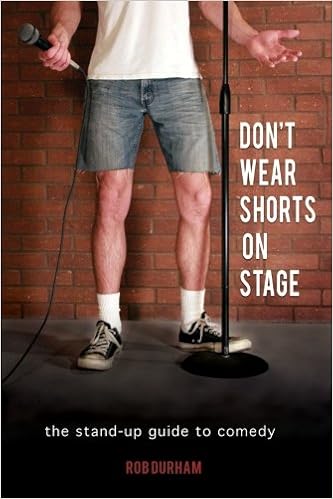
 Don't Wear Shorts on Stage